Is fusion power ready for prime time?
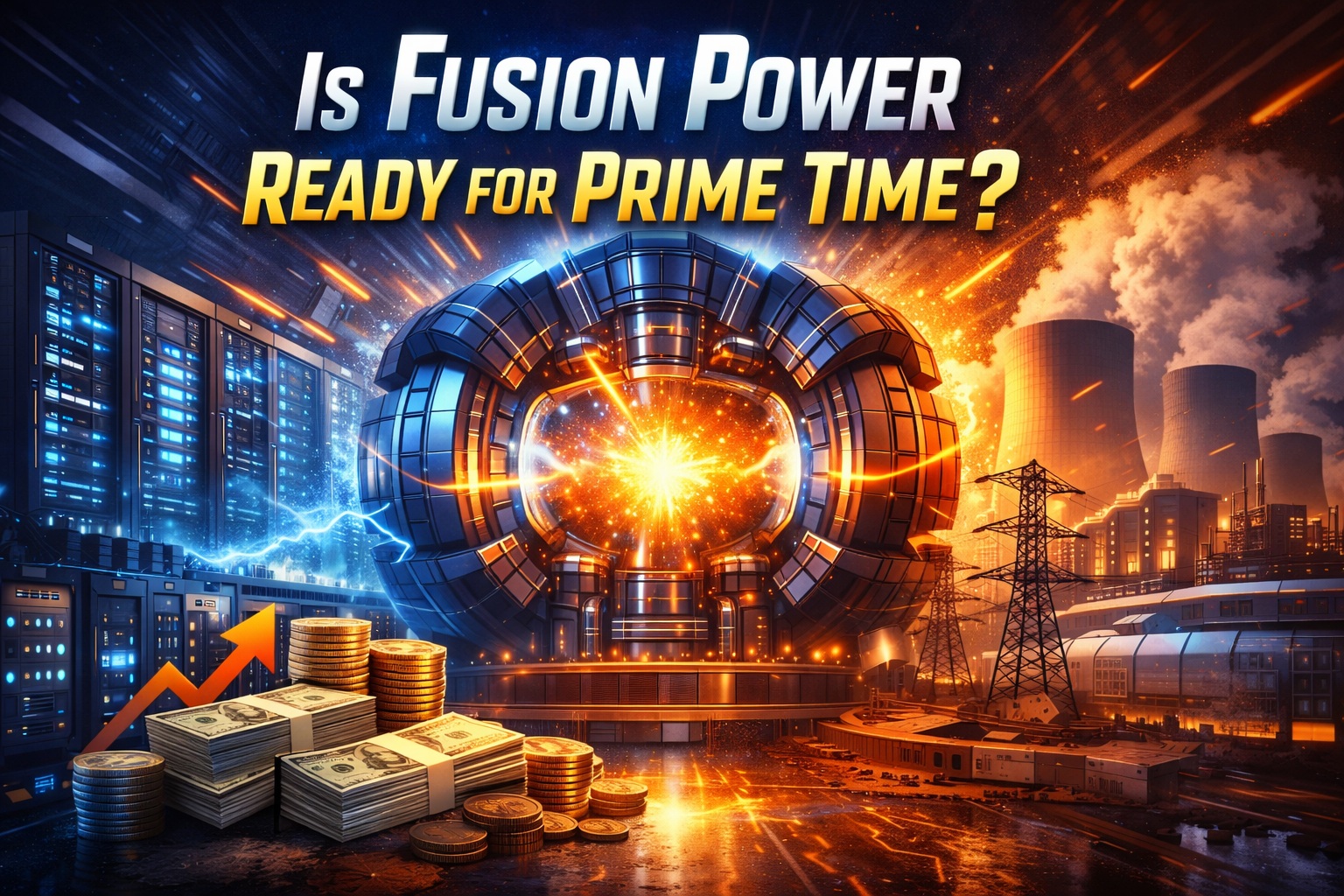
For decades, fusion power has lived in the same mental drawer as flying cars and jetpacks — exciting, elegant, and always “about 30 years away.”
But something has changed.
Quietly at first. Then all at once.
Today, fusion is no longer just a physics experiment. It’s a business race, a strategic energy play, and potentially the missing piece in powering an AI-driven world without burning the planet.
So… is fusion power finally ready for prime time?
Let’s take a clear-eyed look.
Fusion has long been the holy grail of energy:
limitless, carbon-free, always-on, and with minimal waste.
The problem?
Getting more energy out than you put in — and doing it reliably, repeatedly, and affordably.
That barrier is now cracking.
New reactor designs, breakthrough superconducting magnets, and AI-driven control systems have compressed decades of progress into just a few years.
And for the first time, serious people are talking about real timelines, not theoretical ones.
One of the clearest signals comes from Commonwealth Fusion Systems, a company born out of MIT research.
Their reactor, SPARC, is designed to be smaller, faster, and commercially relevant — not a science monument
The key innovation?
High-temperature superconducting magnets powerful enough to hold plasma at over 100 million degrees — while keeping the machine compact enough to scale.
This is not theoretical physics.
This is manufacturable engineering.
Fusion’s biggest accelerant isn’t just physics — it’s computation.
Companies like NVIDIA and Siemens are helping fusion developers use AI, digital twins, and simulation to model thousands of reactor scenarios before metal is ever cut.
That matters because fusion isn’t just about ignition — it’s about control.
And AI is exceptionally good at controlling impossibly complex systems.
Here’s where the story gets very real — very fast.
AI data centers are exploding in size and power demand. Traditional grids are straining. Power availability is becoming a competitive advantage.
Fusion offers something unprecedented:
– Always-on baseload power
– No carbon constraints
– No fuel supply shocks
– Minimal land footprint
This opens the door to fusion-powered colocation facilities — where energy is generated on-site or nearby, bypassing grid bottlenecks entirely.
For hyperscalers and AI labs, fusion isn’t just clean energy.
It’s strategic independence.
This isn’t happening in a vacuum.
Fusion startups have attracted billions in private capital, backed by:
– Big Tech
– Energy majors
– Sovereign investment funds
– Long-term infrastructure investors
Governments are aligned too. The U.S. Department of Energy has openly stated goals of putting fusion on the grid in the 2030s.
That kind of alignment — public and private — is rare.
And when it happens, timelines tend to shrink.
Let’s bring it home.
If fusion succeeds at scale, the implications for everyday people are enormous:
– Lower, more stable power bills
– No fuel price volatility
– Cleaner air without lifestyle sacrifice
– Energy abundance instead of scarcity
Fusion doesn’t replace renewables — it completes them.
Solar and wind handle peaks. Fusion handles the base.
That combination could finally break the cycle of rising energy costs.
So… Is It Ready for Prime Time?
Not yet — but it’s closer than most people realize.
Fusion still needs to prove:
– Long-duration operation
– Cost-competitive construction
– Materials that survive extreme conditions
– Seamless grid integration
But here’s the difference from the past:
– The path is visible.
– The money is committed.
– The customers are waiting.
Fusion is no longer a science question.
It’s an execution question.
At eFind, we track the ideas that reshape the world quietly — before consensus forms and headlines catch up.
Fusion power sits at the intersection of:
– Energy
– AI
– Infrastructure
– Economic opportunity
This is the kind of shift that doesn’t just change industries — it changes assumptions.
And the smartest companies, investors, and builders are already positioning for it.
Fusion may not light up your home tomorrow.
But for the first time in history, it’s no longer science fiction — it’s engineering with a deadline.
And that’s when revolutions really begin.